
The budgeting cycle usually starts with last year’s figures. IT and system line items are increased by a percentage, and then the discussion moves on to something else. In practice, integration and switching booking platforms are rarely treated as a budget issue, because the cost of a mediocre integration does not appear anywhere in the accounts. It sits in labour costs for the employees who fix things manually.
It is one of the more unpleasant line items to spot. The booking platform licence is visible and easy to compare. The hours your people spend entering orders, checking freight invoices, and logging into different portals are invisible because they are spread across the working day.
Before you write next year’s numbers, it makes sense to take stock of what the connection between ERP, webshop, and booking platform actually handles on its own. Not what the vendor says it can do, but what it does in live operations on a busy Friday.
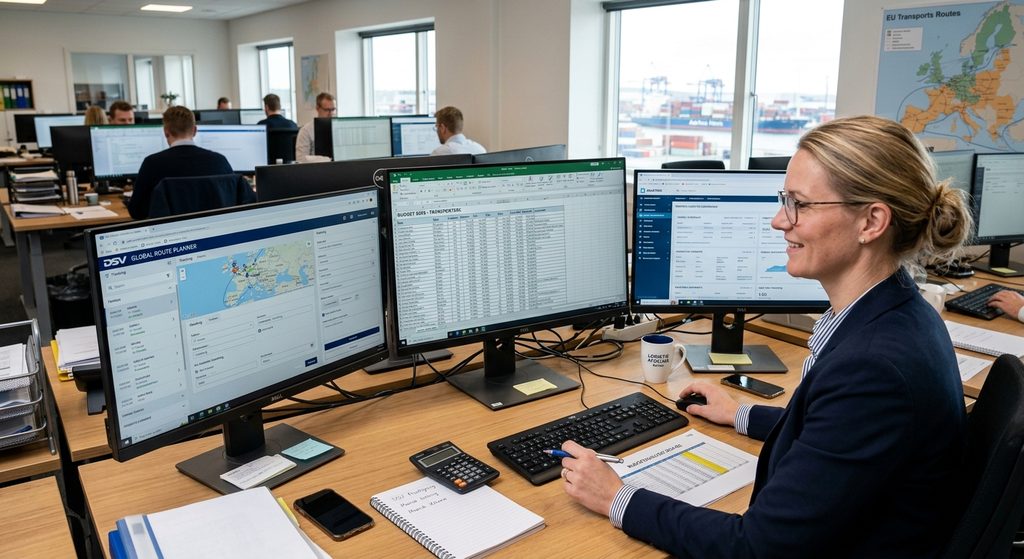
A projected IT line item says nothing about what the integration costs
An integration set up two years ago was assessed once. Since then, new carriers have been added, order volumes have shifted, and the webshop may have gained new fields. None of that triggers an alarm. The integration does not fail; it simply delivers data that someone then has to correct.
That is why the first step is to separate two things: what the system costs on the invoice, and what it costs in working time to keep it running. The second figure is what determines whether a change pays off, and it is also the figure a CEO or CFO can relate to.
When the objection is “that sounds expensive compared with what we have”, it is usually based on the licence price alone. That discussion changes when a calculated number of hours sits alongside it.
In practice, integration and switching booking platforms come down to two things
You can assess an integration on two parameters, both of which can be measured. Data quality is about how much of what comes in can be used without being touched. Operational stability is about what happens when something goes wrong, and how quickly you discover it.
Most reviews go wrong because they stop at the question of whether there is an integration at all. The answer is almost always yes. The interesting part is what share of shipments make it all the way through without human intervention.
Data quality
Take one week of shipments and review them. How many were created, booked, and dispatched without anyone changing the address, line item, weight, or service selection? How many required an employee to look something up in another system?
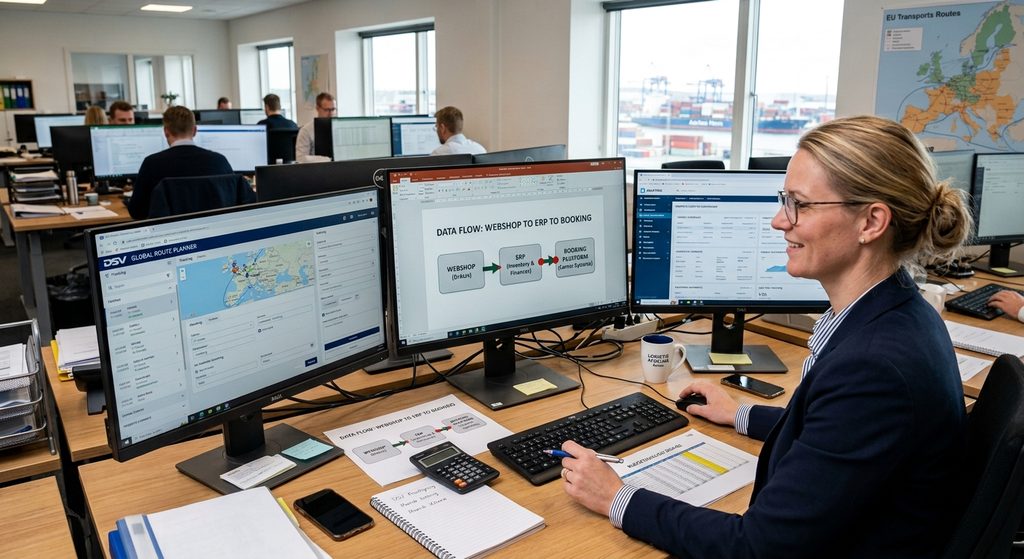
Pay particular attention to the points where data changes hands. When an order moves from webshop to ERP and on to the booking platform, there are at least two handovers, and that is typically where fields do not match. A country code format that does not align, or product information missing for customs documentation, does not trigger an error message. It results in an employee correcting it manually every time.
The error rate on bookings is the direct measure. Typos, rejected bookings, and failed pickups are all symptoms that data is not flowing through cleanly.
Operational stability
Here the questions are different. What happens when a carrier’s API does not respond? Do you get notified, or do you find out when the customer calls? How many shipments typically sit in a queue before anyone reacts?
Operational stability is also about how much the system can handle under pressure. An integration that works fine at 200 shipments a day does not necessarily behave the same way at 600 in peak season. If your warehouse response times get longer in the busy weeks, that is a capacity constraint, not a coincidence.
The number of logins is a useful indicator
If an employee has to go into five different carrier portals to get today’s shipments out the door, it is not just a usability issue. It is an integration issue that has turned into a workflow.
Free courier portals are attractive because they do not cost anything in licence fees. The price is paid elsewhere. Each portal has its own login, its own way of handling labels, and its own invoice format. When the freight invoice has to be checked afterwards, there is no shared data source to reconcile it against, and the check becomes either superficial or time-consuming.
Count how many systems your people are logged into on a normal workday. That number says more about the level of integration than any system description.
How to turn the review into a budget figure
The KPIs you are measured on are already the ones you need. Cost per shipment should include both the freight rate and internal labour costs. Time-to-ship—from when the order comes in until pickup is approved—shows how much of the flow is waiting on a person. The number of shipments processed per employee shows whether capacity keeps up as volume increases.
Quantify the manual work as hours per week, broken down by the tasks that have arisen as a result of the integration. Convert it into labour costs. That gives you an annual cost that can be placed next to the licence price and compared with an alternative.
Also remember the line items that sit outside the logistics department. Customer complaints about shipping cost time in customer service, and for freight forwarders, delivery accuracy is linked to whether B2B customers stay with you.
Fear of downtime is a valid objection
“I am afraid a new system will bring operations to a halt for weeks” is a reasonable concern, and it should be included in the assessment rather than talked down.
What determines the risk is how well you already understand your own data flow. A company that has documented which fields are sent where, which carriers are used for what, and where the current exceptions are has a far better starting point than one that has to figure it out along the way.
That is why the status review creates value, regardless of whether you end up changing anything. Either it documents that the integration is holding up, and you can project the budget with confidence. Or it shows exactly where the cost sits, and you have the foundation ready if you later need to move something.
The objection “we only switched systems two years ago” is worth taking seriously for the same reason. The point of a review is not to replace anything. It is to know what you have.
FAQ
We switched booking platforms two years ago. Does it make sense to look at the integrations already now?
Yes, because it is not the platform that changes, but the conditions around it. New carriers, changed order volumes, and adjustments in the webshop all affect how much can run automatically. A review does not mean you have to change anything. It tells you whether the decision you made two years ago still holds.
How do I price the manual work so a CFO can use the figure?
Calculate hours per week for the specific tasks that arise because data does not flow through cleanly: address corrections, manual invoice checks, duplicate entry. Multiply by an average hourly cost and annualise it. The figure is more credible if it is based on a recorded week rather than an estimate.
Our employees are used to the current setup. How do I have that discussion?
Start by measuring how many systems they have to go through during a day, and which tasks they themselves point to as wasted time. Resistance is rarely directed at a better flow. It is directed at a period when day-to-day work becomes unpredictable, and that concern is addressed with a plan, not with arguments.
In conclusion
An integration rarely becomes bad overnight. It slowly becomes less comprehensive as workflows grow around it. The budgeting cycle is the only time of year when there is a natural reason to look at it, and it is a bad idea to use that opportunity to project a number no one has checked.
If you want a structured way to work through it, you can use our checklist for reviewing integrations between ERP, webshop, and booking platform. It is designed so you can review your current connections and document where they hold up and where they cost manual hours before the budget is locked.

