
When the year is closed, the booking error rate usually ends up as a single figure in a spreadsheet. That figure tells you how often something went wrong, but not what went wrong. And as long as the breakdown is missing, the cost of incorrect shipping data becomes something you accept as part of operations rather than something you can reduce.
That difference matters in practice. A rejected booking doesn’t just cost a new attempt. It costs the time an employee spends finding out why the carrier said no, the time it takes to correct the details and book again, and in the worst case a pickup that doesn’t happen on the day it was promised. Then comes the conversation with the customer, and perhaps an invoice line that doesn’t match what was ordered.
Most logistics managers can name the errors they remember. The pallet that was measured wrong, the address without a gate code, the service product that doesn’t apply on that route. But memory is not a good basis for prioritising. It highlights the dramatic over the frequent, and it is almost always the frequent that costs the most over a year.

Why the error rate as a single figure isn’t much use
A total of two or three percent sounds manageable. The problem is that it doesn’t point to any action. Should you train customer service better? Should order data be validated earlier? Should customer master data be cleaned up? Should a particular service product be removed from the list altogether? All four efforts take time, and without a breakdown you are choosing blindly.
At the same time, the overall figure hides the fact that errors are rarely evenly distributed. Typically, a few error types account for most rejected bookings, and they are often tied to one particular point in the flow. It might be a carrier with stricter requirements for address data, a particular type of goods, or a customer group whose master data has never been maintained.
Once the breakdown is visible, the conversation changes. It is no longer about “errors happening”, but about three specific things in your flow producing them.
How to break down the year, error by error
The exercise doesn’t have to be big. It requires a list of rejected bookings and missed pickups from the year, and a categorisation of them.
Start by pulling out data for the whole period. If bookings are spread across several carrier portals, collecting them becomes manual work, and that in itself is a point worth noting. If you can’t pull your own error data out in one place, you can’t follow it on an ongoing basis either.
Then categorise each rejection. Some error types recur in most setups:
- Address errors, typically a missing or incorrect postcode, house number or gate code
- Missing contact details for the recipient, so the carrier can’t send notifications
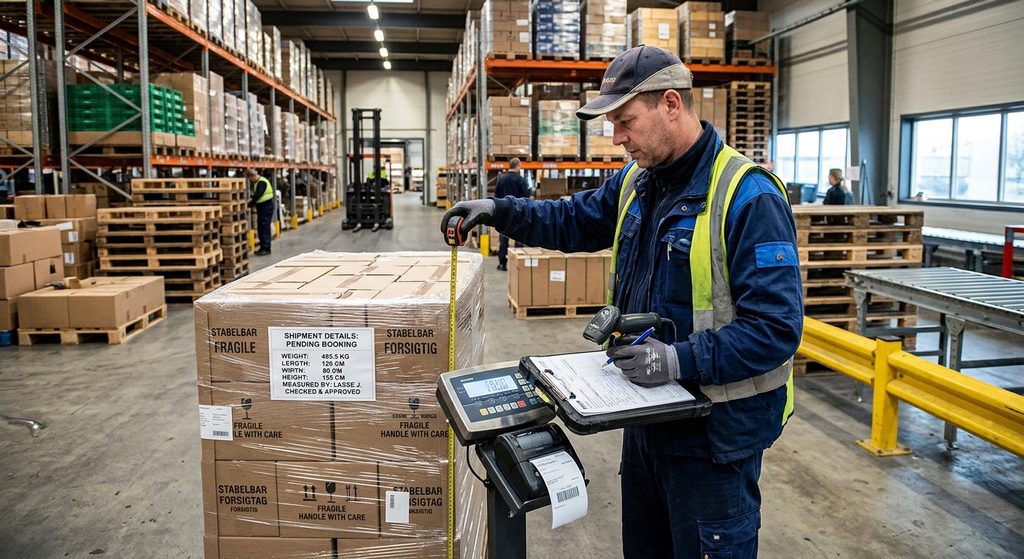
- Weight and dimensions that don’t match the actual goods
- Incorrect parcel or pallet specification, for example a EUR pallet registered as a loose parcel
- Service products that aren’t valid on the route in question or for the type of goods
- Missing or incorrect customs and export documents on shipments outside the EU
- Pickup time windows that the chosen carrier can’t meet
- Incorrect sender or account details
- Duplicates, where the same shipment is booked twice
- Missing references, so the shipment can’t be matched to the order
For each error, note where in the flow it originated. Did the information come from the order system, from a customer, from manual entry in the warehouse, or from a master data record that was never updated? That field is what makes the analysis useful.
Finally, put a rough time estimate on each error type. How long does it take to detect, correct and rebook? An estimate from the employees who actually do the work is good enough. Multiplied by the number of incidents, you get the cost of incorrect shipping data in salary costs, and that figure tends to surprise more than the freight cost does.
What the breakdown tells you
Once the list is complete, the errors usually fall into a few patterns.
Errors that occur at data entry. If a large share of rejections are caused by typos in addresses, weights or references, the problem isn’t the employees. It’s that the same information has to be entered several times, often in different carrier systems with different fields and formats. Every repetition is a chance to get it wrong. The solution is to move data automatically from order to booking, so it is only entered in one place.
Errors that occur in master data. If the same recipients keep appearing on the error list, it isn’t a data entry error. It’s a maintenance error. Here it makes sense to clean up a defined group of customers rather than train the whole organisation.
Errors that occur in product selection. Rejections due to invalid service products usually mean that the person booking can’t see the carrier’s rules at the time of booking. It’s a question of what the system allows, not what the employee knows.
Errors that occur in the warehouse. Discrepancies in weight and dimensions often belong here, and they typically reappear as re-invoicing from the carrier. If you also check freight invoices manually, that time should be included in the cost of this particular error type.
The breakdown also tells you where it doesn’t pay to act. If customs documents account for a handful of rejections in a year while address data accounts for hundreds, the priority is settled.
From error list to action next year
Most of the error types on the list share the same root cause. The information already exists in a system, but it doesn’t travel on to the carrier by itself. It gets retyped, copied or guessed along the way.
That’s why it makes sense to assess each error type against one question. How early in the flow can this information be validated? The closer to the order, the cheaper the correction. An address caught as invalid in the order system costs seconds. The same address caught by the carrier the next day costs a rebooking and a delayed pickup.
This is exactly why integration with your own systems and with the carriers you actually use carries more weight than the list price per shipment. A setup where shipping data flows from order to label without intermediate steps removes entire categories of errors at once instead of reducing them one by one.
And it doesn’t have to be a big IT project. With maintained plugins for common systems and an open API for what is specific to you, the flow can be adapted to how it looks today, without the whole booking process having to be rebuilt first.
FAQ
Where do I find data on rejected bookings when it is spread across several carriers?
Start with what you have. Many pull an export from each carrier portal and combine them in one spreadsheet for the period. It’s cumbersome, but it only has to be done once to see the breakdown. Once you know which error types dominate, the next question is whether that data can be collected in one place going forward, so the review becomes ongoing instead of annual.
How many error categories make sense to work with?
Enough to distinguish between errors with different causes, and no more. Eight to ten categories is usually plenty. If the list gets longer, you spend more time categorising than correcting. The most important thing is that two errors in the same category can be solved with the same effort.
We don’t have resources for an IT project right now. Can we still do something?
The review itself requires no system changes. It can be done with existing data and a spreadsheet. After that, you can tackle the error types in order of size, and several of them can often be handled by cleaning up master data or adjusting which service products are available. Only once the cheap efforts have been used is it relevant to look at integration.
An error rate rarely falls because someone decides it should. It falls when you can see which errors are the expensive ones, and where in the flow they are created. The review takes an afternoon, and it provides a basis that holds for the whole of next year.
Want a starting point for the categorisation? We are putting together the checklist “10 errors that get your bookings rejected”. Write to us, and we’ll send it to you as soon as it’s ready.


