
Most transport agreements are negotiated thoroughly once. Then they sit in a drawer. Volume changes, destinations shift, weight classes move, but the agreement keeps running as if it were still 2022.
It is rarely a mistake anyone made. It is simply what happens when you do not have a fixed method to measure the agreement against reality. And it is expensive. Often far more expensive than the discounts originally negotiated.
This article is about optimizing transport agreements and freight data. It addresses how you can continuously measure whether the agreement still matches your actual shipping patterns, or if the variance has grown large enough that it is time to reopen negotiations.
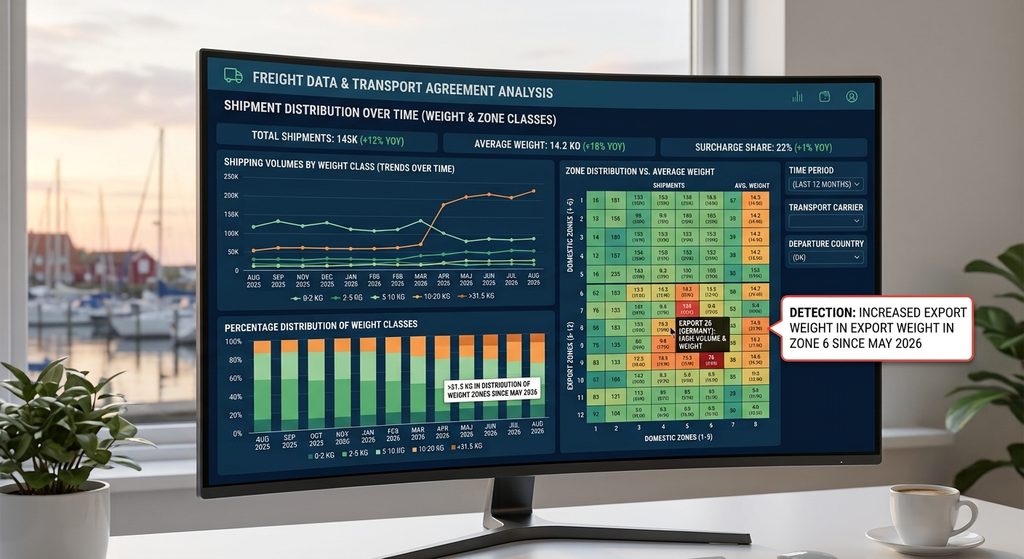
Why Agreements Become Outdated Without Anyone Noticing
A transport agreement is a snapshot in time. It is built on what you knew about shipments when you negotiated: number of packages per month, average weight, split between domestic and export, the percentage of packages over 31.5 kg, how many go to private addresses, and how many are dangerous goods.
All of that can change in twelve months without anyone internally noticing. New customers mean new destinations. A new product means new dimensions. A seasonal campaign pushes volume into a zone where the discount is far less attractive than the one you thought you were getting.
The result is an agreement that still looks fine on paper, but in practice only covers a fraction of what you actually ship. The rest runs at list price or on surcharges that no one pays attention to.
Four Signals That the Agreement No Longer Matches
There are very clear signs if you know where to look. They can all be found in the freight data.
- The distribution across weight and zone classes has shifted. Compare the distribution used during negotiations with your current distribution. If 40 percent of your packages are shipped to a zone with a low discount, while most of your good discounts lie in a zone you barely use, the agreement is working against you.
- Surcharges account for more than expected. Fuel surcharges, address surcharges, oversized items, rebookings, manual handling of surcharges are often the item that grows most unnoticed because they do not appear in the negotiated price list. If surcharges make up 15–25 percent of your total freight expenses, there is cause for review.
- The proportion of shipments outside the agreement’s sweet spot is rising. Most agreements excel in a specific segment for instance, packages between 5 and 20 kg to the Nordic region. If you are increasingly shipping palletized goods, dangerous goods, or to countries outside the agreement’s core coverage, that volume typically runs on non-negotiated rates.
- Invoice-to-agreement match-back is lagging. If you cannot systematically reconcile each individual shipment against the price that should have been billed, there is no way of knowing whether the agreement is actually being upheld. Billing errors and incorrect surcharges are everyday occurrences in the industry, not exceptions.
A Simple Method for Continuous Measurement
You do not need a full BI setup to keep track. You just need to check the same metrics every quarter.
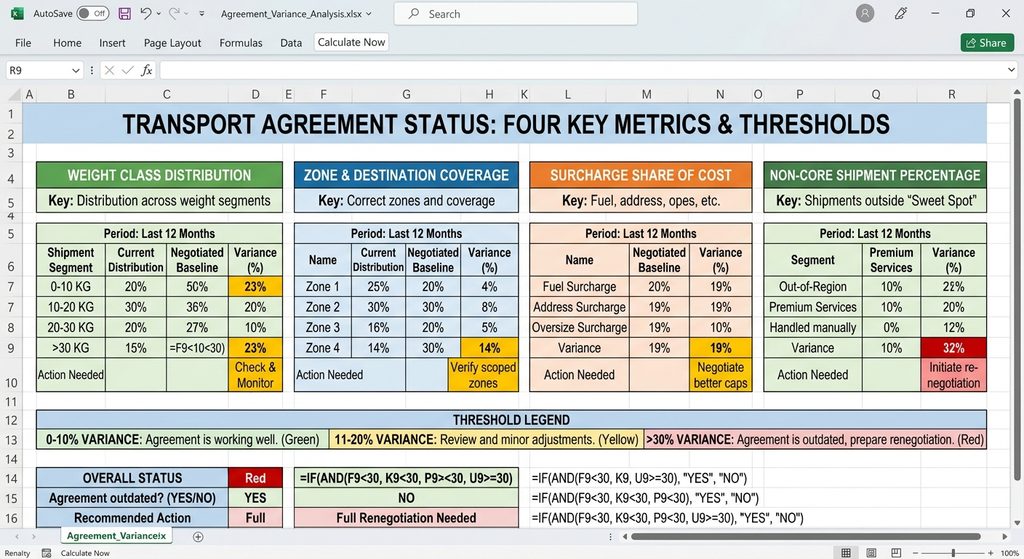
Extract freight data for the latest period and compare it to the baseline used when negotiating the agreement. Four key figures reveal most of the story:
- Distribution of shipments across weight classes
- Distribution across zones and destinations
- Share of total cost spent on surcharges
- Share of shipments falling outside the agreement’s primary coverage
If the numbers remain within a 10 percent variance from the baseline, the agreement is operating sensibly. If they deviate by 20 percent or more on even a single parameter, there is reason to look closer. If they exceed a 30 percent variance, the agreement is effectively outdated.
It is not about renegotiating every time the numbers shift. It is about knowing when the variance is large enough to make a renegotiation worthwhile.
What to Look For in the Freight Data Itself
The strongest starting point is a line-item review looking at individual shipments rather than a aggregated monthly statement.
- Examine the average price per package, broken down by weight class and zone. Compare it with the negotiated rate for that same category. If a systematic difference exists, the issue lies either in billing or in the fact that shipments do not fall into categories covered well by the agreement.
- Examine the top 20 percent most expensive shipments in the period. This is often where hidden costs reside. A large portion of expensive shipments is typically not due to the package being unique, but because it hit a bad spot in the agreement’s structure.
- Examine surcharges per invoice. Are specific types of surcharges recurring? Business address surcharges that were actually private addresses, oversize surcharges on packages close to the limit that could have been packed differently, or manual handling on packages that could have been labeled correctly from the start.
From Measurement to Action
Measurement only has value if it leads to a decision. There are typically three outcomes:
- The agreement still matches. The matter is settled until next quarter.
- The agreement matches partially, but adjustments can be made without full renegotiation. Perhaps a single surcharge agreement needs adding, or a specific zone should be handled via another carrier. This does not require a major negotiation, just a dialogue with the carrier regarding a specific area.
- The agreement no longer matches. A renegotiation should be initiated using a data foundation that shows precisely where the variance lies. A negotiation built on actual freight data from the last 6–12 months reaches a very different outcome than one built on assumptions or the carrier’s own figures.
FAQ
How often should you check if a transport agreement still matches?
Quarterly is sufficient for most. If you ship highly variable volumes or are in a growth phase, monthly reviews can make sense. Annually is too infrequent, as variances have time to grow significantly over twelve months.
How large a variance is required before renegotiation pays off?
There is no fixed limit, but when key metrics (weight distribution, zone distribution, surcharge percentage) deviate by 20 percent or more from the original foundation, there is usually enough at stake to make a renegotiation worthwhile.
Can carrier-provided reports be used to measure agreement performance?
They can serve as a starting point, but they are rarely sufficient. Carrier reports show what you paid, not whether you should have paid it. An independent review of freight data against the agreement terms provides a far more accurate picture.
Keeping a transport agreement up to date is not about constant renegotiation. It is about knowing when the agreement is still working for you and when it has begun working against you. That insight lies within the data it just needs to be brought to light.
