
Most logistics managers only discover the problem when it is already right in front of them. For months, the error rate sat comfortably at a couple of percent, and suddenly corrections, credit notes, and angry customer emails take up half the workweek. Volume has increased by 40 percent. Errors have jumped by 200.
This is a classic pattern when a company outgrows its booking solution. The error percentage rarely increases linearly with the number of shipments. It explodes because the manual workarounds and informal agreements that kept the process together at lower volumes do not scale. An employee can keep twelve special rules in their head. Not seventy.
This article addresses what actually drives booking errors during growth, and how templates, validation rules, and fixed workflows keep the error rate down when shipment volume climbs.

Why Errors Explode Instead of Rising Linearly
At low volumes, every booking is essentially a small, handcrafted task. The booker checks the address, double-checks the weight, and perhaps calls the warehouse to confirm the piece count. The system is the person.
When volume doubles, two things happen simultaneously: the time per booking is halved, and the number of rare edge cases increases. Dangerous goods to Norway. Customers requiring packing slips in English. Addresses with gate codes that must go into a specific field. Special rules that were previously handled ad hoc are now overlooked because there simply is no time to remember them all.
As a result, errors do not spread evenly. They concentrate around the most complex customer types and the busiest days—precisely where they cost the most.
Templates Are Not Standardization—They Are Systematized Memory
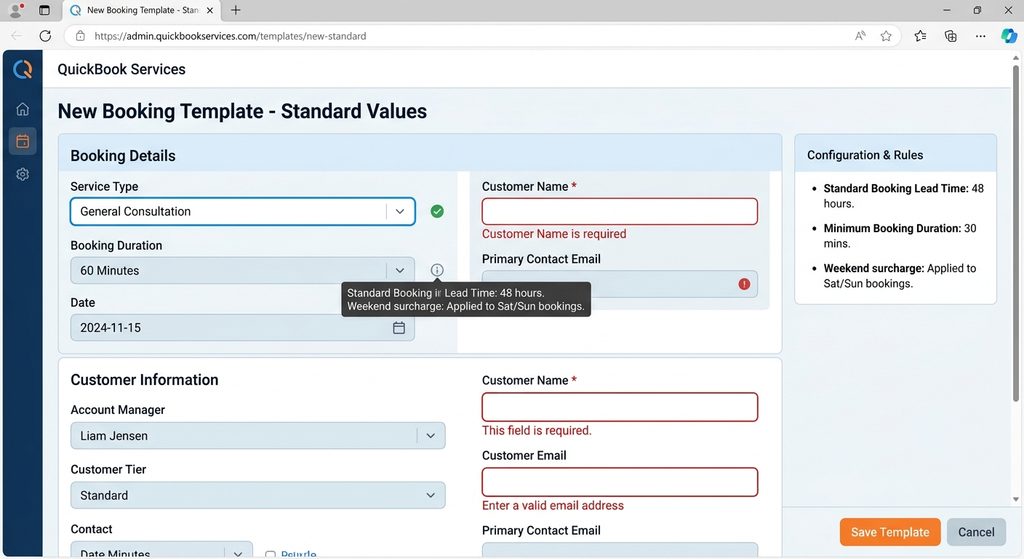
Many logistics managers dismiss templates because they associate the word with rigid, standard solutions that do not fit reality. That is a misconception. A good template is not a straitjacket; it is a way to ensure that the knowledge inside an experienced booker’s head is still available when they are on vacation.
A practical template includes, at minimum:
- Default values for fields that are typically identical (sender address, package type, carrier)
- Fixed selections for customer-specific requirements (labels, documents, incoterms)
- Pre-filled fields for recurring routes or recipients
The goal is not to remove flexibility. The goal is to allow the booker to focus their attention on what is unique about a shipment, rather than what is identical every time.
Validation Rules Catch Errors Before They Become Costly
The next component is validation. A booking error discovered in the system prior to dispatch costs minutes to fix. The same error discovered when the driver arrives at the loading dock, or when a parcel returns from Germany, costs hours and often real money.
Validation rules should target the most expensive error types. Typical examples:
- Weight and dimension limits per carrier, preventing a pallet from being booked with a carrier that cannot handle it
- Mandatory documentation rules for exports outside the EU
- Postal code verification against the country, so a Danish address does not end up routed to Sweden
- Missing reference alerts for customers that require a specific sender reference
Rules should not be overly generic. They must reflect the actual errors your company has experienced. Look through the last three months of credit notes and complaints; you will find a complete library of validation rules that should have been active.
Fixed Workflows Eliminate Hidden Decisions
The final element is establishing a structured sequence for the workflow itself. This is not because bookers lack skills, but because the human brain makes more mistakes when forced to make numerous small decisions under time pressure.
A fixed flow means the booker does not have to decide which carrier to use for a given customer type, which label template to select, or when to generate customs documents. The system suggests the correct choice based on the customer, destination, and freight. The booker simply confirms or consciously overrides.
This is where the difference between a flexible platform and a standard platform becomes clear. A standard platform forces every customer through the exact same flow. A flexible platform lets the flow reflect each company’s actual workflow, including the exceptions and special rules that exist in practice.
Order of Operations Matters
When reducing booking errors as volume grows, it is tempting to tackle everything at once. That is rarely the fastest path. A more pragmatic sequence is:
- Map actual errors from recent months and group them by customer type and error category.
- Build templates for the five to ten customer types that represent the majority of your volume.
- Set up validation rules against the most expensive errors, not necessarily the most frequent ones.
- Formalize the workflow for the most complex shipments, while letting simpler ones run as before.
This sequence ensures that efforts to reduce errors remain proportional to the value created. It is also an approach that can be implemented without halting daily operations.
When the Platform Itself Is the Problem
Sometimes errors are not a sign of poor processes, but rather that the booking platform no longer fits the business. If your system cannot support customer-specific templates, does not allow validation rules beyond the most basic ones, or forces all bookings through the same flow regardless of complexity, the platform itself is generating the errors.
This is one of the clearest signs that a company has outgrown its booking solution. Not that the system is slow or outdated in appearance, but that it cannot reflect the actual operational complexity the business handles.
FAQ
What is a normal error rate for a booking operation?
There is no single benchmark number because error rates depend heavily on what you measure. Some companies only count errors that trigger credit notes, while others include corrections made prior to dispatch. The specific figure matters less than whether it grows disproportionately when volume increases—that is the primary indicator that a process fails to scale.
Can error rates be reduced without switching platforms?
Often yes, at least to a point. Templates and fixed workflows can frequently be built on top of existing systems if the platform permits it. The limit is reached when validation rules become so complex or customer-specific that the platform cannot handle them. At that stage, spreadsheet workarounds and manual cheat sheets become source errors in themselves.
How long does it take to implement templates and validation rules?
It depends on the number of customer types, special rules, and the accessibility of past error data. A pragmatic approach starting with the five to ten most critical customer types can often go live within a few weeks. Full coverage takes longer, but complete rollout is not required to start seeing results.
Booking errors are rarely caused by carelessness. They are a sign that a process is carrying more complexity than it was designed to handle. As volume rises, those design limits become visible—and that is precisely when templates, validation rules, and structured workflows deliver their value.
