
ROI on automation: What can you expect? Automation of booking processes
If you’re still handling transport bookings that require too much manual work, you probably know the feeling. One booking may seem harmless, but as volume grows, the manual part quickly becomes what makes the day unpredictable. And that’s often when automating booking processes comes into play.
The trigger is usually very concrete. The growing time spent on manual booking processes becomes unsustainable. You start spending more time coordinating than solving the customer’s real needs, and you feel the consequences when you lose customers because you can’t offer the transport solutions they expect.
In that situation it makes sense to talk about ROI. Not as a PowerPoint exercise, but as a practical calculation. What is the current way of booking costing you in time, mistakes, and missed opportunities? And what can you realistically expect to gain by uniting more carriers on a single platform and reducing the number of manual steps?
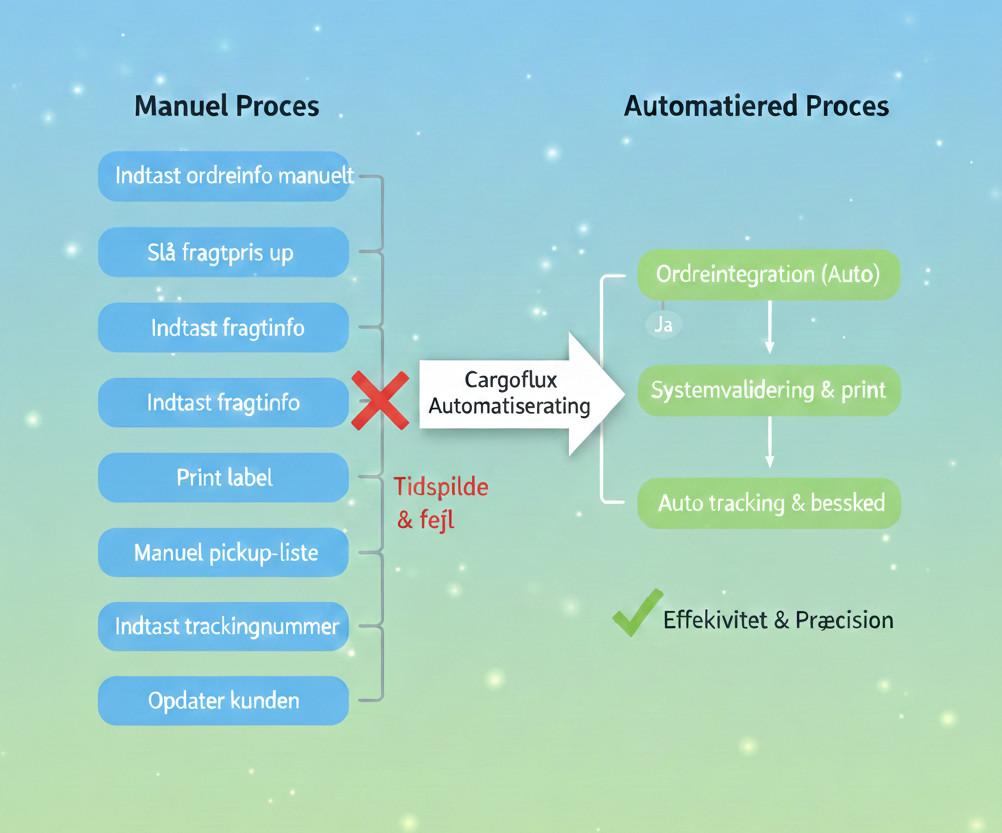
Automation of booking processes. What exactly are you paying for?
When people say “automation,” it can sound big and vague. In practice, it’s about removing the manual steps that make booking heavy and vulnerable.
Take a typical situation. A booking begins with a request, and then time is spent finding a suitable transport option, gathering information, confirming, updating internally, and replying to the customer. When you do it across multiple systems or through manual workflows, it quickly turns into a chain of small tasks.
Automating booking processes typically delivers value when you: - reduce the number of manual steps in the booking itself - avoid having employees re-enter the same information in multiple places - manage more carriers in one place instead of switching between systems - respond faster so you don’t lose customers because you can’t offer the needed transport solutions
The key is to make it measurable. ROI only becomes useful if you can point to what actually changes in day- to-day work.
How to calculate ROI without guessing
You don’t need a perfect business case to get started. You need a calculation that’s honest and can be updated as you get more data.
Here’s a simple model you can use.
Step 1. Map your current booking process in minutes
Start by describing the process as it actually happens, not as it should happen.
Write down the key steps and estimate the time per booking. Examples of steps you can measure: - receiving and clarifying booking data - choosing the transport solution - executing the booking - internal updates and customer confirmation - changes, cancellations, and follow-up
You don’t have to hit it exactly to the second. You just need to see the order of magnitude.
Step 2. Assign an internal hourly rate to the work
ROI often gets muddied because people hesitate to put a price on time. But if time is scarce, it has value.
Choose an hourly rate that makes sense for your company. It can be an internal cost or a fully loaded cost. The point is to use the same rate before and after so the comparison is fair.
Step 3. Calculate the monthly cost of manual work
Formula:Monthly cost = monthly booking volume × minutes per booking ÷ 60 × hourly rate
Once you have it, you have a baseline number. That number is your “manual tax.”
Step 4. Describe what the automation changes in the process
Here you should be conservative. Don’t say everything becomes automatic. Describe which steps you expect to remove or shorten.
Examples of realistic changes you can test: - fewer clicks and less duplicate data entry - less time switching between carriers because you bring them together on one platform - a faster booking flow because standard choices and data are ready
Step 5. Calculate the break-even point
Formula:Break-even in months = investment ÷ monthly savings
The investment can be licensing, implementation, and internal time. If you don’t know it precisely yet, you can work with a range and see how sensitive your ROI is.
Concrete calculations you can adapt to your booking volume
You asked for concrete calculations based on company size and booking volume. We can do that, but we need to keep the figures as examples because we don’t have your actual times, hourly rates, or costs as input.
So here are three templates. They’re designed so you can swap the numbers with your own.
Scenario A. Low volume, but high friction
Bookings per month: 200 Minutes per booking today: 10 Minutes per booking after automation: 6 Internal hourly rate: 400 DKK
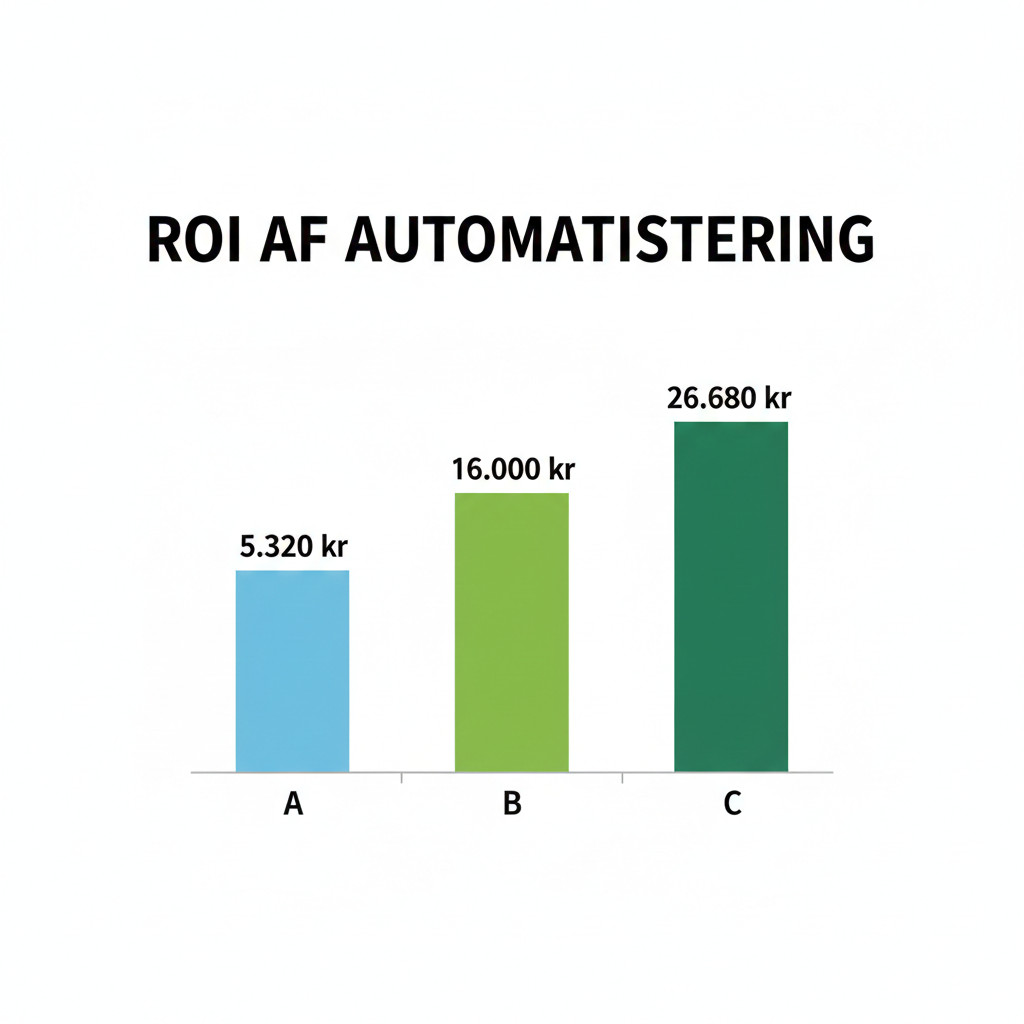
Calculation: Time today per month = 200 × 10 ÷ 60 = 33.3 hours Time after per month = 200 × 6 ÷ 60 = 20 hours Savings = 13.3 hours per month Savings in DKK = 13.3 × 400 = 5,320 DKK per month
Here ROI is often not only a question of kroner. It’s also about making sure the growing time spent doesn’t become unsustainable as volume increases.
Scenario B. Medium volume, clear capacity gain
Bookings per month: 800 Minutes per booking today: 8 Minutes per booking after automation: 5 Internal hourly rate: 400 DKK
Calculation: Time today per month = 800 × 8 ÷ 60 = 106.7 hours Time after per month = 800 × 5 ÷ 60 = 66.7 hours Savings = 40 hours per month Savings in DKK = 40 × 400 = 16,000 DKK per month
At that scale, you usually start to feel like you have a choice. You can use the time you free up to handle more bookings without hiring. Or you can spend it ensuring you don’t lose customers because you lack transport solutions.
Scenario C. High volume where standardization becomes critical
Bookings per month: 2,000Minutes per booking today: 6Minutes per booking after automation: 4Internal hourly rate: 400 DKK
Calculation:Time today per month = 2,000 × 6 ÷ 60 = 200 hoursTime after per month = 2,000 × 4 ÷ 60 = 133.3 hoursSavings = 66.7 hours per monthSavings in DKK = 66.7 × 400 = 26,680 DKK per month
High volume isn’t just about minutes. It’s also about robustness. When a process depends on manual steps, it becomes vulnerable when something changes. More carriers, more variations, more urgent jobs.
What you can realistically expect to “gain” beyond time
ROI is often reduced to time savings because it’s easiest to measure. But in your context there are two other things that typically drive the decision, because they match your trigger events.
1. You reduce the risk of losing customers over transport
When you lose customers because you lack transport solutions, it’s rarely because you don’t want to help. It’s because the process makes it slow to find and assemble options.
If you can bring more carriers under one platform, it becomes easier to match the customer’s needs without starting from scratch each time. It’s not a promise of more customers. It’s a more robust way to keep transport from becoming a bottleneck.
2. You make booking less dependent on specific people
Manual processes tend to live in the heads of a few people. When they’re busy or unavailable, throughput drops.
Automating booking processes is therefore also about making the flow more consistent. Not because everything needs to be rigid, but because you want to scale without everything depending on one person’s overview.
3. You get a better basis for deciding the next steps
When you’ve mapped minutes per booking and volume, you get a language for improvement. That makes it easier to prioritize which processes to automate first and which ones aren’t worth touching yet.
The typical pitfalls when calculating ROI on automation
There are three classic places where ROI calculations become misleading.
You assume everything will be automated
If you build a business case assuming the entire process becomes “hands off,” it’s almost always too optimistic. Instead start with the steps that repeat the most and clearly can be shortened.
You underestimate internal time
Even when a solution works, the change still requires internal resources. Processes need to be documented, and people have to work in a new way. If you ignore that, the ROI doesn’t become fake. It just becomes useless as a management tool.
You forget what triggered the need
If the trigger is that the growing time consumption is becoming unsustainable, then ROI isn’t just money. It’s also predictability. If the trigger is that you lose customers because of transport, then your ROI model needs a place where you can talk about lost opportunities without having to put an exact figure on it from day one.
FAQ
How do I know if the automation of booking processes are worth it for us?
Start by measuring how many minutes a booking takes today, then multiply that by your monthly volume. If you can shave off just a few minutes per booking, you can quickly see whether there’s a meaningful monthly saving worth pursuing further.
Do I need high volume before it makes sense to automate?
Not necessarily. A lower volume can still be relevant if friction is high or you often lose customers because you lack transport solutions. Volume amplifies the impact, but the need can exist beforehand.
What is the most practical way to get started with an ROI calculation?
Create a simple baseline for time per booking and monthly volume. Use the same hourly rate across all scenarios. Then calculate what happens if you reduce the time per booking by 1, 2, or 3 minutes. That way you can see the sensitivity without guessing too much.
The next step is that you spend one week measuring the time per booking for 20 random bookings and note the booking volume for that same period. That way you have a concrete starting point for calculating ROI on automation, instead of it being a theoretical exercise.