
API vs manual integration: What works best? Integration and system migration in practice
If you are in the middle of an integration and system migration, it’s rarely because it’s “exciting.” It’s because something in operations hurts. It usually starts when booking processes become more and more manual and the time spent grows until it’s no longer bearable.
At the same time, another pressure can arise. You lose customers because you cannot offer the transport solutions they expect. Or because you cannot bring multiple carriers together on one platform, so you end up handling exceptions and special rules manually.
In that situation, many people end up asking the same question. Should we build an API integration, or should we create a more manual integration? The technical choice sounds small. The consequences are not.
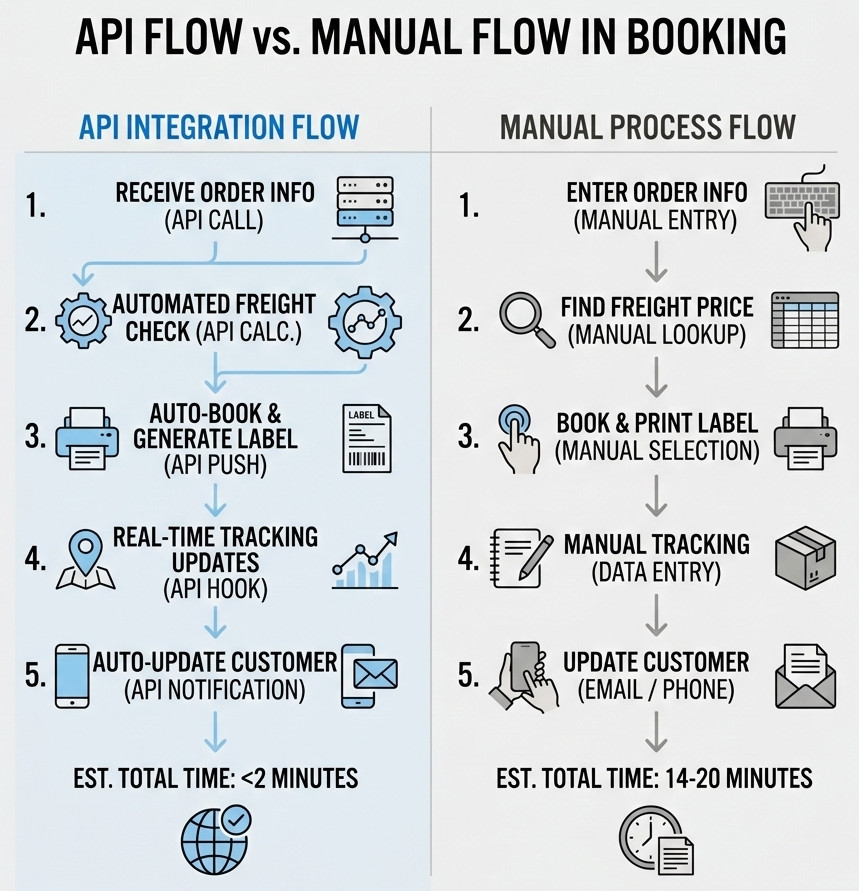
What do we actually mean by API vs. manual integration?
Let's get the terminology straight so you can make a decision without talking past your colleagues.
An API integration is a way for systems to exchange data through a defined interface. It matters when you want data to flow more directly between systems, and when you want to avoid having people move information manually between screens.
A manual integration is, in practice, anything that is not a direct system-to-system exchange. That can be manual steps in a booking process, file export and import, or an employee copying data from one system to another. In a busy operation, it can be “temporary.” It just often becomes a permanent part of everyday work.
When you work with integration and system transitions, the choice is not about what is most elegant. It is about what matches your needs, your resources, and the reality you are facing right now.
When an API makes the most sense in an integration and system transition
An API sounds like a technical choice, but it is often an operations choice disguised as technology. An API typically makes the most sense when your trigger events are already in place.
1. When manual booking processes can no longer keep up
If the increasing time spent on manual booking processes has become unsustainable, it is a sign that you have too many repetitions and too many places where data needs to be entered or moved.
In an integration and system transition, an API can be a way to reduce the number of manual touchpoints. Not to “automate everything,” but to remove the steps that create bottlenecks.
2. When you need to bring multiple carriers together on one platform
If the need is to bring multiple carriers together on one platform, the integration quickly becomes what determines whether the platform feels unified or like a collection of loose ends.
An API can support a more consistent way of handling carriers because you can work with the same type of data flow across them. That is especially relevant if you otherwise end up with different manual routines for each carrier.
3. When missing transport solutions cost you customers
If you are losing customers because of missing transport solutions, that is in itself a strong trigger. It points to the fact that your current setup does not match customer needs.
Here, an API can be relevant because it can make it easier to connect transport options to your platform or your processes without having to run everything manually. It is not a promise that everything becomes easy. It is a direction that typically fits better with the need to expand the range of transport solutions without increasing manual work to the same degree.
When a manual integration can actually be the right choice
It is tempting to make API the default answer. That would be a mistake. There are situations where a manual integration is the most responsible choice, especially when you are in the middle of an integration and system transition and have many moving parts.
1. When you need to get started without rebuilding everything
If the pressure is urgent and you need to address a lack of transport solutions quickly, a manual integration can be a way to get a solution up and running while you plan a more robust integration.
It is not “bad engineering.” It is prioritization. But it requires honesty about what is temporary, and what risks becoming permanent.
2. When the complexity lies in the business, not in the technology
Sometimes it is not the data exchange that is difficult. It is the rules, the exceptions, and the internal decisions. If you are still figuring out what your booking process should look like, it can be costly to automate something that is not stable yet.
Here, a manual integration can be used as a deliberate “learning layer.” It gives you the chance to clarify process and responsibility before committing to a specific technical implementation.
3. When the resources for maintenance are not in place
An API integration is not just a project. It is also something that has to be kept running. If you do not have the capacity to follow up, fix issues, and update integrations as part of operations, a manual solution may be more realistic for a period of time.
It does not mean you should stay there. It means you need to time your integration and system transition so the technology matches your ability to operate it.
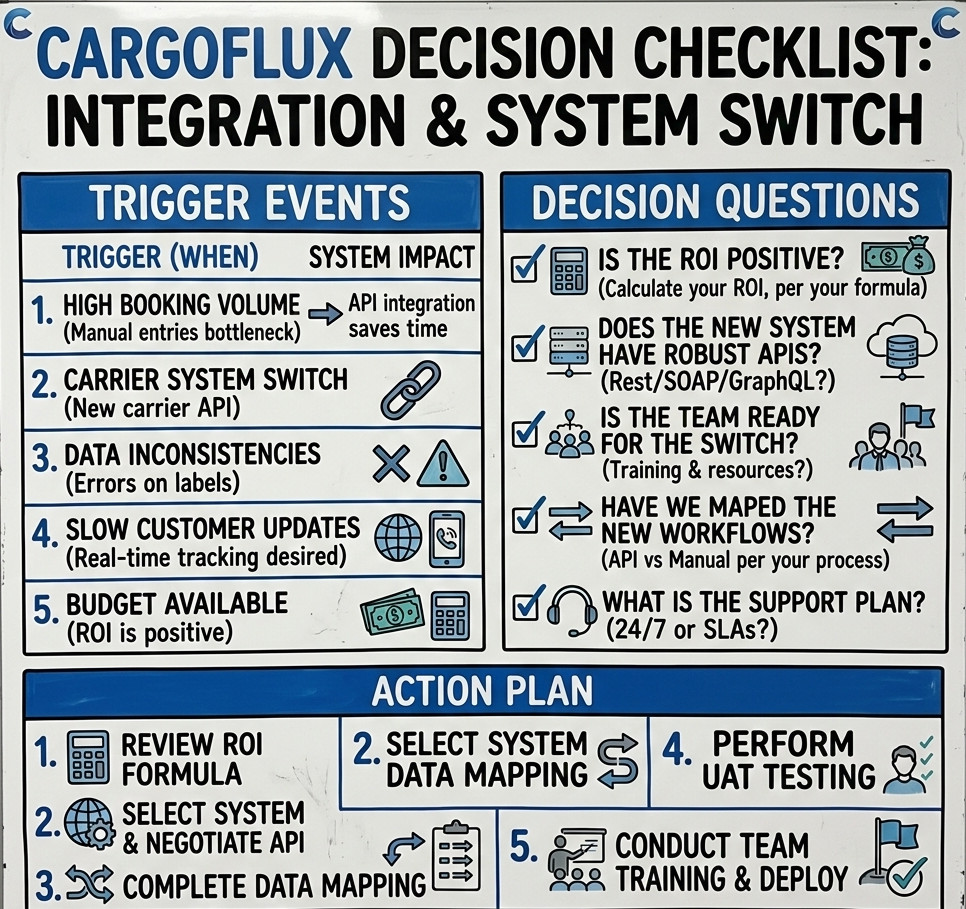
Decision framework. Choose based on operations, not preference
If you want to make the choice concrete, you can use a simple framework. It does not require a large analysis effort. It requires you to answer honestly.
Question 1: Where does it hurt the most today?
You already have three clear signals in play if they apply to you. The time spent on manual booking processes has become unsustainable. You are losing customers because of missing transport solutions. You need to bring multiple carriers together on one platform.
If the pain points are mainly about time and repetition, that often points toward an API. If the pain points are about getting a solution into operation quickly, manual integration can be a first step.
Question 2: What needs to be stable after the system transition?
Integration and system transitions are rarely just about moving data. They are about establishing an operation that can hold up.
If the most important thing after the transition is that the booking process is consistent and does not depend on “who happens to be on duty,” then that is an argument for reducing manual steps. API can be part of that.
If the most important thing is to be able to offer transport solutions more broadly, without necessarily having all processes perfectly standardized yet, a manual integration can be a controlled compromise.
Question 3: Which tasks do you not want more of?
Imagine your day-to-day three months after you have made the choice. If you do not want more tasks involving manual booking, corrections, and re-entry, you should be careful about building a solution that adds more manual steps. If you do not want more tasks involving technical troubleshooting, updates, and coordination between systems, you should be careful about starting with an API integration without having clarified operational responsibility.
This is not to scare you away from API. It is to make sure your integration and system transition does not create a new kind of bottleneck.
A pragmatic approach. Combine them, but do it deliberately
Many end up with a combination. Some parts are integrated via API, while others are handled manually for a period of time. That can be a good solution if you set clear boundaries.
Imagine that you are bringing multiple carriers together on one platform. You can choose to start by handling part of the flow manually to get the platform working in practice. At the same time, you can identify the most time-consuming manual steps in the booking process and prioritize those for API first.
The important thing is that the manual part does not just become “everything we did not get to.” It should be a deliberate choice with a clear owner and a plan for when you revisit it.
Typical pitfalls in integration and system transitions
Here are three things that often make the choice harder than it needs to be when you are deciding between API and manual integration.
1. Choosing technology before you have a shared view of the problem
If some people on the team mainly feel the time spent on manual booking processes, while others mainly feel the loss of customers because of missing transport solutions, you can end up discussing the solution before you agree on the priority.
Start by agreeing on which problem you are solving first.
2. Underestimating what “manual” means in operations
A manual integration is not free. It costs time, and it creates dependence on specific people and routines. If you are already in a situation where manual booking processes are unsustainable, be careful about building in even more manual work.
3. Believing that an API automatically solves the business problem
API can reduce manual steps, but it does not in itself solve an unclear process or unresolved responsibilities. If you want to bring multiple carriers together on one platform, you still need to decide how you handle variations, exceptions, and internal decisions.
FAQ
What is the most important thing to clarify before we choose API or manual integration?
Clarify which problem is pressing you most right now. Is it the time spent on manual booking processes, losing customers because of missing transport solutions, or the need to bring multiple carriers together on one platform? The choice only makes sense once the priority is clear.
Can we start manually and switch to API later without regretting it?
Yes, but only if you do it deliberately. Define which parts are manual, who owns them in operations, and when you will revisit them as part of your integration and system transition. Otherwise, you risk the manual solution becoming permanent.
How do we know whether our manual booking processes are “unacceptable” enough to justify API?
When the time spent has become unsustainable for you, that is a clear signal in itself. Use it as a decision criterion. If the manual work is already a trigger event, it is logical to examine where API can remove the most repetitive steps.
The next step is to make a list of your manual steps in the booking process and mark the ones that are directly tied to the three trigger events. Then choose one part that should be less manual after your integration and system transition, and use it as a pilot for your integration choice.