
Freight invoices typically arrive once a month, often as a PDF containing hundreds of line items. Someone in accounts payable opens it, looks at the total, compares it to the previous month, and approves it. If the total is roughly what it usually is, it moves along to payment.
This is where the hidden costs in freight and invoice management live. Not in the major line items, but in $5 surcharges, a recalculated volumetric weight on a single pallet, or a failed pickup fee that was charged without anyone noticing. The individual amounts are too small to trigger a response on their own, and there are too many for anyone to review manually.
The logistics manager is aware of the problem, but rarely has the time to do anything about it. Meanwhile, accounts payable lacks the necessary baseline because they cannot see what the shipment was originally booked at. Without that reference point, auditing freight invoices is essentially guesswork.
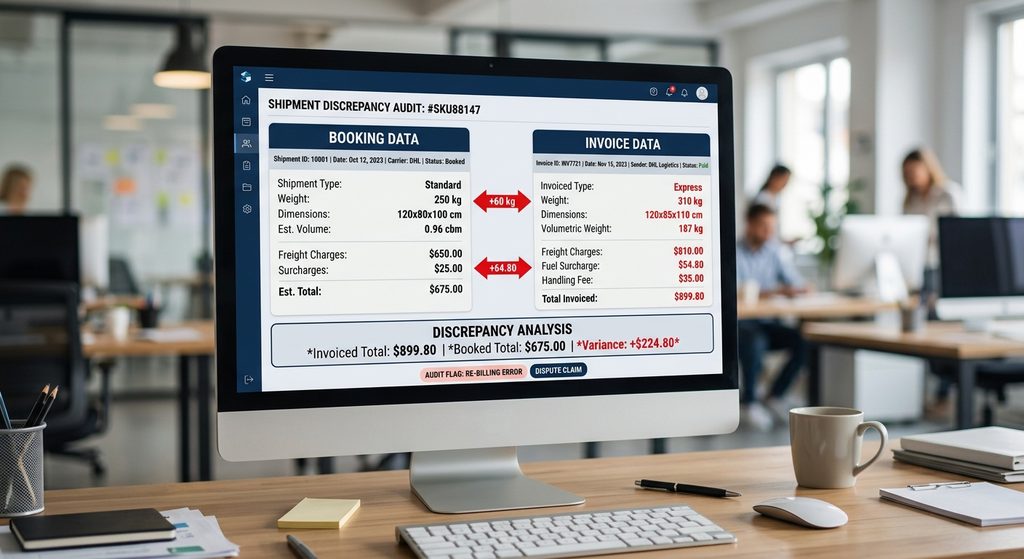
This article explains how to automate that process, so your team only spends time on the line items that actually deviate.
Where the Discrepancies Come From
Re-billing does not happen because the carrier is trying to cheat you. It happens because the price you book at is based on the information you enter yourself, while the price you are invoiced for is based on what the carrier measures at their terminal.
The typical sources are well known in the industry:
- Volume or weight discrepancies, where the package is scanned at different dimensions than what was booked
- Surcharges not included in the original price, such as fuel surcharges, residential delivery, island surcharges, or address corrections en route
- Failed pickup or waiting time at the loading dock
- Duplicate billing for the same shipment, often when a booking was canceled and recreated
- Incorrect zone or product service, where a shipment is billed as express instead of standard
Each of these is legitimate in a certain percentage of cases. The problem is that no one can tell which ones.
Why Spot Checking Doesn’t Solve It!
The standard reaction is to introduce spot-checking. You take 20 lines a month and check them manually. This gives a general sense of things, but it fails to catch systematic errors on low frequency surcharges and does not provide a solid foundation when going back to the carrier.
At the same time, it consumes valuable time. Every single line requires finding the original booking, locating the tracking number, looking up the agreed rate, and making a comparison. If the bookings are spread across four different carrier portals, you have to log into four different places just to check one invoice. It is the exact same friction that slows down booking in the first place.
One hour of manual auditing per week might not sound like much. Over the course of a year, that adds up to a full work week spent looking at invoice lines that, in the vast majority of cases, are completely correct.
The Foundation Is the Booked Price
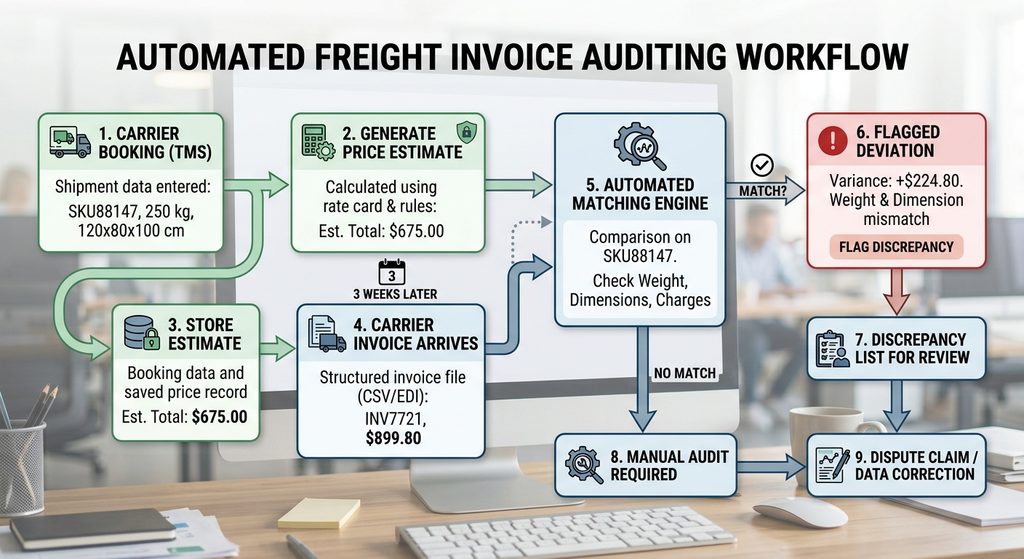
Automated invoice auditing stands or falls on one thing: having a saved, machine readable price for every single shipment at the time of booking.
It sounds simple, but that is precisely what is missing in most setups. When booking is done directly in the carrier’s portal, the price only exists as a visual display on the screen. It is not saved anywhere under your control. When the invoice arrives three weeks later, you have nothing to hold it up against other than your master contract, which has to be interpreted manually for every single line.
If, on the other hand, shipments are booked through a single system via API connections to your carriers, every shipment gets an estimated price attached to it, along with weight, dimensions, product type, and destination. That is your reference point. Without it, implementing the rest of this process is impossible.
How to Set Up the Audit Process in Practice
- Get Invoice Data in a Structured Format A PDF cannot be matched automatically. Ask your carrier to supply the invoice as a structured file with one line per shipment, typically CSV or an Excel. Most major carriers can provide this, and many already do if asked. If you use multiple carriers, you will receive multiple file formats, which need to be normalized into a single structure before the matching process can run.
- Match on Tracking Number, Not Amount The key connecting your booking to the invoice line item is the shipment or tracking number. Ensure this number is stored on the order in your system, and that your internal order or customer reference is passed along with the booking. That way, any discrepancy can be traced back to a specific order and customer, rather than just a random reference number in the carrier’s system.
- Define a Tolerance Threshold If the system flags every single penny of variation, your team will be overwhelmed by noise and stop reviewing the alerts. Set a threshold, for instance, flag deviations over $4 or over 5% of the total shipment cost, whichever is triggered first. Adjust this limit after a month once you see how many flags it generates.
- Categorize Discrepancy Types A $5 price difference tells you nothing on its own. The valuable insight is knowing whether it stems from a re-measured volume, a surcharge, or a duplicate charge. Map the line item fee codes from the invoice into distinct categories so you can group them. You only have actionable data once you can see that 60 of the month’s flags belong to the very same issue.
- Build the Workflow Around the Exceptions Automation should produce an actionable list, not a report that no one opens. A simple split works best for most teams. Discrepancies within the tolerance limit are approved automatically. Discrepancies above the threshold are routed to the logistics manager, showing the booking data and invoice line item side by side. Repeated discrepancies of the same type are grouped into a single claim against the carrier, rather than submitting a hundred individual claims.
- Close the Loop Back to Booking This is where the greatest long-term value lies. If 80% of your volumetric weight discrepancies stem from the same SKU, the issue isn’t the carrier. It is the dimensions stored in your own product database. Update those details, and the discrepancies disappear. Automated invoice auditing is as much a data quality tool as it is a financial control tool.
What You Can Measure Afterward
Once the auditing process is running smoothly, you gain access to data you never had before.
You can calculate the true cost per shipment including surcharges, rather than relying solely on the quoted rate. You can identify which carriers deviate most frequently and on which specific routes. You can document error rates when it comes time to renegotiate freight contracts. And you can accurately track how many hours are spent on invoice processing instead of guessing.
For a CFO or finance director, that last point is often what drives the decision. Discussions around adopting new software are rarely about subscription costs alone; they are about understanding the internal labor cost per shipment in your current process.
Is It Worth It?
The return on investment depends on your shipment volume. At a few hundred shipments per month, a structured manual review may be sufficient, provided the booked price is saved somewhere accessible. At several thousand shipments per month, manual auditing becomes unfeasible, and the question is no longer whether to automate, but how quickly you can implement it.
It is worth noting that the financial return rarely comes as one massive lump sum refund. Instead, it comes as an ongoing reduction in discrepancies, as both your internal data and the carrier’s billing become more accurate when consistent oversight is applied.
FAQ
Can I implement automated invoice auditing if we book directly in the carriers’ own portals? Only partially. You can ingest the invoice and look for duplicate charges or unusual surcharges, but you cannot compare the billed amount to the originally booked price because that data is not stored in a format you control. For a true automated audit, bookings must go through a platform that saves the estimated price for every shipment.
How long does setup take? The matching logic itself is relatively straightforward. The primary workload involves getting structured invoice data delivered from each carrier and ensuring your internal references are passed through during the booking process. Implementation time therefore depends mostly on how many carriers you use and how standardized your master data is to begin with.
Does filing claims for many small amounts damage the relationship with the carrier? In practice, the opposite is true provided the claims are backed by solid data and submitted in consolidated batches rather than one off complaints. Carriers can easily address structured documentation that highlights a recurring pattern on a specific route or item type. A stream of a hundred loose emails about minor fees is frustrating for both parties.
Final Thoughts
Invoice auditing will never be an exciting topic. However, it is one of the few areas in logistics where manual work can be shifted from humans to software without disrupting day-to-day operations. The booking process remains unchanged, warehouse operations run as usual, and the finance team receives a clean, prioritized list of line items that actually require human attention.
If you want to dive deeper into where hidden costs occur between the booked quote and the final paid invoice, you can download the whitepaper “Where the Money Disappears in Your Freight Budget.” It provides a solid foundation for building an internal business case to review your current freight auditing process.
