
When did carrier visibility become business-critical? Carrier consolidation and visibility in practice
Carrier consolidation and visibility may sound like something that belongs in an optimization round when there is finally time for it. But at some point, it shifts from being a practical improvement to becoming something that directly determines whether you can deliver the shipping solution your customers expect.
If you are dealing with manual booking processes that keep growing in time consumption, you probably know the feeling. It often starts as small exceptions. An extra carrier here. A special agreement there. A colleague who “just happens to have a contact.” Suddenly, it is no longer manageable to see what options exist and who can handle what.
And when you also find yourself losing customers because you cannot offer the right shipping solutions, visibility stops being an internal project. It becomes business-critical.
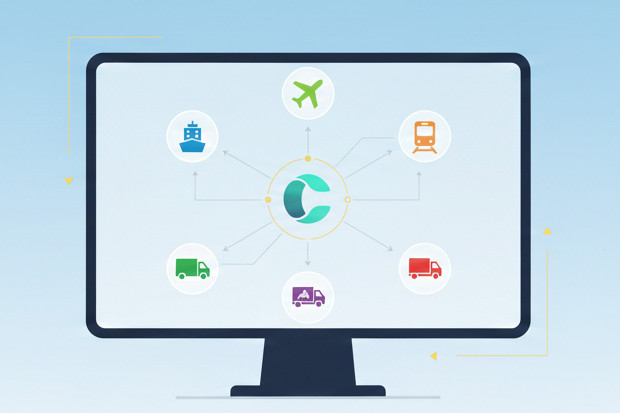
When does it shift from “smart” to “critical”?
There are typically three trigger events that make carrier visibility a necessity. You have already mentioned them. They are the same ones that keep coming up when shipping needs grow faster than the processes around them.
1. When manual booking processes become unsustainable
It is not necessarily because your team cannot handle it. It is because the manual way of booking often scales poorly.
As volume increases, the number of small decisions increases as well. Which carrier fits this job? Who has capacity? What requirements does the customer have? What did we do last time? If the answers are scattered across inboxes, spreadsheets, and people’s heads, then “booking” turns into a constant interruption.
That is when carrier visibility becomes critical. Not as a dashboard for appearance’s sake, but as a way to turn booking into a controlled process instead of constant firefighting.
2. When you lose customers because the shipping solution does not match their needs
The main challenge is clear. Missing or inadequate shipping solutions for your customers’ needs.
It may be that you actually have a carrier that could handle the task. You just do not have visibility of it in the moment. Or you do not have a simple way to bring the options together so you can quickly choose the right one.
When that happens, carrier visibility stops being an internal convenience issue. It becomes a competitive parameter. Not because you have to promise faster delivery or lower prices, but because you need to be able to say yes to more relevant jobs with confidence.
3. When you need to bring multiple carriers together on one platform
When you have multiple carriers in play, the number itself is not the challenge. It is the friction between them.
Each carrier typically means more process variations, more ways of booking, and more places to find status and information. If you want to bring them together on one platform, it is often because you want one way of working even though you have multiple providers.
That is a sign that carrier visibility has already become critical. You are no longer just trying to “keep track of it.” You are trying to standardize it.
What does “carrier visibility” actually mean in day-to-day operations?
It is tempting to define visibility as “a list of carriers.” But that is rarely where the value lies.
Visibility only becomes business-critical when it helps you make decisions quickly and consistently. Take a typical situation. An order needs to go out, the customer has a specific requirement, and you need to choose a solution without wasting unnecessary time searching for information or asking around.
Carrier consolidation and visibility are therefore about two things at once: that you can access multiple carriers in one place, and that you can work in a way that makes booking less dependent on individual people and ad hoc knowledge.
You can easily have many carriers and still lack visibility. And you can have only a few carriers and still need consolidation if the booking process has become too manual.
5 concrete benefits you can realize within 30 days
In the abstract, you have already set a clear framework. Not “total transformation,” but concrete benefits that can be felt quickly. Here are five that connect directly to your trigger events and the main challenge.
1. Less time spent on booking because the choice becomes more straightforward
When the booking process is manual, you spend time finding information, clarifying options, and getting confirmations in place.
With better carrier visibility, the goal is not to automate everything from day one. The goal is to make it easier to choose because the options are gathered and available when you are handling the task.
Within 30 days, you can typically: identify the booking steps that take the most time bring together access to the carriers you use most often make “this is how we book” more consistent across the team
2. Fewer lost opportunities because you can actually match the customer’s needs
When customers drop off because of the shipping setup, it is often because the solution cannot be presented quickly and confidently enough.
Carrier consolidation and visibility help you bring more relevant options into play without having to go on a manual hunt every time. It is not a promise that every job can be solved. It is about not losing jobs because you lack visibility into the solutions you already have access to.
Within 30 days, you can focus on: the customer types or job types where you most often lack a suitable solution which carriers cover which needs, so you can choose faster
3. Less dependency on individuals in the booking process
When booking is manual, knowledge quickly becomes person-dependent. Who knows which carrier handles that type of job? Who has “the right contact”? Who can make things happen?
It works until it does not. Illness, holidays, workload, or growth make it fragile.
Carrier visibility makes it easier to distribute work and onboard new colleagues because access and process are more unified.
Within 30 days, you can typically: define a shared minimum process for booking ensure that more people on the team can book the most common shipments without help
4. Easier to work with multiple carriers without creating more complexity
You mention a concrete need: bringing multiple carriers together on one platform.
This is often where companies are caught off guard. More carriers do not have to mean more hassle if access and workflows are consolidated. But if each carrier requires its own way of doing things, you get the opposite.
Within 30 days, you can work with a pragmatic prioritization: start with the carriers that deliver the most value or are used most often bring them together so you get a consistent booking experience even though the providers are different
5. Better internal stability because you can manage shipping as a process
The last point is often what turns a “nice-to-have” into a “need-to-have.”
When you lack visibility, shipping becomes a constant interruption. When you have visibility, it becomes a process you can plan, distribute, and improve.
It’s not about making everything perfect in 30 days. It’s about feeling that everyday life becomes more controlled and less reactive.
Within 30 days you can typically: gain a shared understanding of what “good booking” means for you; reduce the most recurring clarifications and bottlenecks
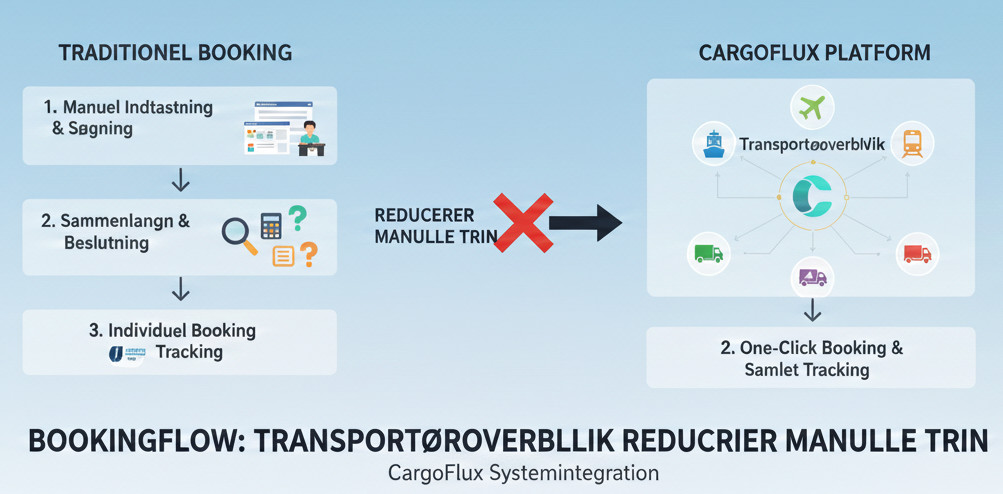
How to get started without turning it into a huge project
How to get started without turning it into a huge project? If you try to consolidate everything at once, you risk ending up in analysis and cleanup instead of moving forward. A more practical approach is to start where your trigger events are already putting pressure on you.
Step 1: Pick the one part of the flow that hurts the most
Step 1: Pick the part of the flow that hurts the most. Ask yourself: Where is the manual time investment becoming unsustainable right now?
It could be: - the booking itself - figuring out which carrier fits - coordinating when something changes midstream
Choose one. Not three.
Step 2: Prioritize carriers by usage, not by how many exist
Prioritize carriers by how often you use them, not by how many there are
Start with the carriers that are most relevant to the jobs you actually handle. That's the quickest way to feel an effect without promising yourself a total overhaul.
Step 3: Decide what “visibility” should be able to answer
Visibility doesn’t need to look pretty. It just needs to be useful.
Spell out the questions you want to answer fast. For example: - What carrier options do we have for this type of job? - How do we book without having to start from scratch every time? - How do we consolidate multiple carriers so the team works the same way?
Keep it at a level that can be implemented and used.
FAQ
What do you mean by carrier consolidation and overview?
That you bring access to multiple carriers together and create a clear overview, making it easier to choose and book without wasting time on manual processes.
When is carrier overview business-critical?
When manual booking processes become unsustainable, when you risk losing customers over the transport part, or when you need to bring multiple carriers together on one platform.
What is a realistic first step if we want to get started within 30 days?
Choose the part of the booking flow that currently causes the most friction. Then prioritize the carriers you use most, and define which questions your “overview” needs to answer on a day-to-day basis.
The next concrete step is to write down your three most time-consuming booking steps and choose one of them as your 30-day focus. Once you can point to that, it becomes much easier to gather carrier access and create an overview that actually gets used.