
Most booking processes are not designed. They evolve organically. First came one carrier, then came the customer demanding another, and then came the export orders with customs documents. Each time, a new layer was added, and each time it worked because the volume was manageable.
It lasts longer than you might think. At 50 daily shipments, a skilled logistics coordinator can keep most of it in her head. She knows that the customer in Hamburg must be booked no later than 1:00 PM, that one carrier rejects bookings without the correct ZIP code format, and that pallets above a certain height need to be split up. That knowledge is written nowhere. It lives with one person, and it works.
The problem arises when the company outgrows its booking solution. Not suddenly, but as a gradual shift where the same routines begin to cost more than they deliver. It is rarely the booking itself that collapses. It is everything surrounding the booking that no one has quantified.
If you expect to double your volume within a couple of years, the question is worth asking now, while you still have time to rebuild without doing it in the middle of a peak season.
Why 200 Shipments Isn’t Just 50 Times Four
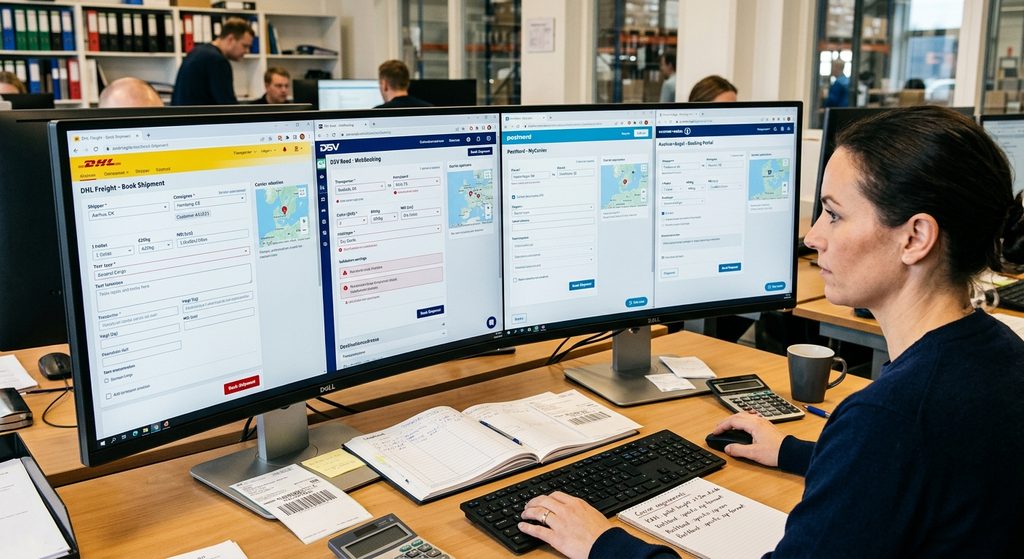
Manual booking scales linearly. Four times as many shipments means four times as many logins, data entries, and labels. That is the part everyone can figure out.
What comes as a surprise is that the rest does not scale linearly. The exceptions grow faster than the core volume because more shipments also mean more destinations, more carriers, and more customer agreements, each with its own requirements. Errors increase accordingly, and they become more expensive because there are fewer minutes to catch them before the goods leave.
At the same time, the nature of control work changes. At 50 shipments a day, you can still find time to review invoices and catch discrepancies that look off. At 200, invoice auditing turns into random sampling, and random sampling means that a systematic error in a freight agreement can run for months before anyone notices. This is where a portion of the invisible freight leakage occurs.
And then there is key person dependency. The knowledge that sat comfortably in the mind of one coordinator at 50 shipments now has to be shared across three people on shifting turns. Either it gets written down in a spreadsheet that nobody keeps updated, or it turns into three different ways of doing things.
The Elements That Need to Be Built Differently From the Start
If the goal is a process that still functions at double the volume, there are several areas where it pays off to build things right from the beginning.
A single entry point for all carriers. As long as booking happens across five different portals, every new carrier costs another login, another workflow, and another place for data to diverge. A unified access point turns carrier selection into a strategic choice rather than an operational burden. It is also the prerequisite for comparing prices and delivery times across carriers in the first place.
Data that originates from the source. Every time an address, weight, or item number is manually typed into a booking portal, a risk of error is introduced. Integration with your ERP and webshop does not just eliminate repetitive typing; it also removes the entire category of errors caused by two systems having different versions of the truth. If you handle exports, the same applies to customs data.
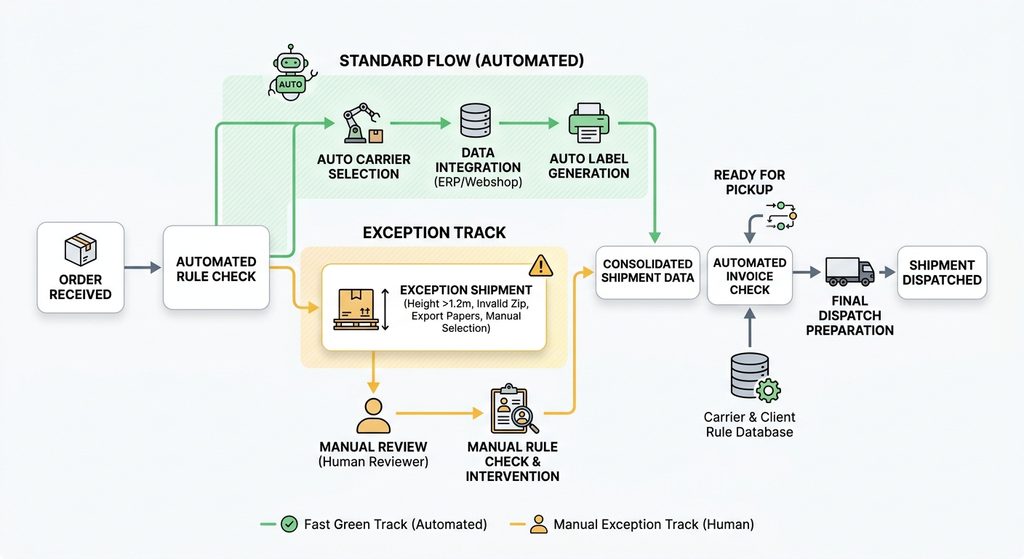
Rules instead of habits. The decision regarding which carrier to use for a given shipment must be expressible as a rule: weight, destination, customer contract, and deadline. When the rule resides within the system, it makes the exact same decision every time, no matter who is on duty, and regardless of whether it is a chaotic Friday.
Exceptions must have their own dedicated track. A process that assumes everything will run smoothly breaks down the moment something does not. Instead, design the process so that standard shipments flow through without human intervention, ensuring that shipments requiring evaluation become visible immediately. This is the only way to increase the number of shipments per employee without raising the error rate.
Automated freight invoice auditing. Verification should be performed programmatically against the booked rate, not through a manual review whenever someone finds spare time. As volume grows, this is where the difference between contracted and invoiced freight costs turns into real money.
Metrics from day one. Cost per shipment, including internal labor costs. Time-to-Ship, measured from when the order lands until pickup is confirmed. The booking error rate. Without these numbers, you cannot identify when the process begins to break down, nor can you quantify the value of an improvement.
Do the Math Before You Discuss Price
The objection to making a change almost always sounds the same: “It sounds expensive compared to what we have today.”
That is a fair objection, but it only becomes a true comparison when both sides of the equation are included. Take your own estimate for how many minutes a booking takes on average from the moment the order is ready until the label is printed, including all associated logins and lookups. Multiply that by the number of shipments, and scale it up to the volume you expect two years from now. Add the hours spent on invoice audits and cleaning up after failed pickups.
That number represents your current operating cost at future volume. That is what a new solution should be measured against not the subscription price in isolation.
The Fear of Shutting Down Operations
The concern that actually drives most of these decisions is rarely about price; it is about risk. No logistics manager wants to be the person who halted shipments for three weeks because a new system had to be implemented.
That fear is justified enough that it must be addressed explicitly. A few key strategies significantly reduce that risk:
Run systems in parallel for a period where the legacy process remains available as a fallback. Start with a single carrier and one shipment type preferably the most standardized one and expand from there. Schedule the implementation outside your peak season. And agree upfront on the response times if issues arise during the first few weeks, because that is when the quality of vendor support proves critical, not during the sales pitch.
The objection that employees will never accept a new system is worth taking seriously, but it often points to something other than reluctance. People resist systems that slow down their daily work. If the new process eliminates four logins and half an hour of invoice auditing a day, the picture typically looks very different after a couple of weeks. Test it with the end users before making the final decision.
FAQ
We just changed systems two years ago. Does it make sense to look at it again now?
That depends on whether the system you switched to was sized for the volume you handle today and what you anticipate for tomorrow. A system selected for 50 daily shipments and two carriers was chosen based on assumptions that may no longer apply. Start by measuring how many minutes a booking actually takes today, and compare that to your original assumptions. If the number has increased, the process itself not the age of the system is your argument.
What is the most important thing to fix first if we cannot do everything at once?
The underlying data foundation. As long as addresses, weights, and item details are typed manually into bookings, any automation layered on top will inherit those errors. Furthermore, integrating with your ERP or webshop delivers an immediate return by eliminating manual data entry, regardless of how far along you are with the rest of the rollout.
How do we know whether the process or the volume is the actual problem?
Look at your error rate over time. If the number of rejected bookings and failed pickups is growing faster than your overall shipment count, the issue lies in the process. If they are growing at roughly the same pace, the bottleneck is capacity. These two scenarios require entirely different solutions, and hiring your way out of a process problem is an expensive mistake.
In Conclusion
A booking process built to sustain double the volume does not look like your current setup with more hands on deck. It looks fundamentally different because it is engineered around a core assumption: humans should only touch shipments that require a manual decision.
The best time to rebuild is while there is still operational breathing room. The worst time is after the volume has already doubled.
If you want to evaluate where your current setup stands, you can download the guide “7 Signs Your Booking Solution Isn’t Keeping Up With Growth.” It serves as a practical starting point to determine internally whether you are outgrowing your current setup.
