

Every month, the freight invoices arrive. Someone sits down with a spreadsheet, a stack of booking confirmations, and a cup of coffee. Then the work of cross-checking line by line begins. Weight, zone, surcharges, fuel surcharges, weekend surcharges, address corrections, dimensions.
After two hours, half of it is checked. After four hours, eyes are getting tired. After six hours, the last 200 lines are approved with a quick glance because something else is more urgent.
This is where the hidden costs in freight and invoice control arise. Not because the employee is careless, but because manual auditing of large volumes of data can never be entirely accurate. It is a reality of human capacity, not a flaw in the person.
Why the Eyes Miss the Errors
A typical freight invoice from a major carrier contains 30–40 columns per line item. Packages, weight, dimensions, sender, recipient, service type, zone, base rate, fuel surcharge, address surcharge, re-weight surcharge, weekend surcharge, VAT code, and a handful of reference numbers.
If you have to cross-check that against booking data, you must locate the corresponding booking, compare all relevant fields, and assess whether any discrepancy is justified. Multiply that by 500 or 2,000 shipments a month, and you are looking at a task that no one can realistically perform error-free.
There are three recurring patterns when companies later discover what they have overpaid for:
Systemic discrepancies that look like noise. A few extra dollars per shipment seems like nothing. But when repeated across 1,500 shipments, it becomes a five-figure sum a year. Manual auditing filters these out as “insignificant” because the human mind automatically dismisses small numbers when under pressure.
Surcharges that shouldn’t be there. A weekend surcharge on a weekday delivery. An address correction for an address that was correctly entered during booking. A re-weight surcharge on a package booked in the correct weight class. Catching these errors requires going back to the original booking data to prove them—something very few people do when things are busy.
Price increases that sneak in. Agreed rates change slowly over time. A zone shifts. A new surcharge is introduced. A discount expires without notice. Without automated comparison between the expected and actual price, this is often only discovered when someone happens to stumble upon the total by chance.
Why Spot Checks Aren’t Enough
A common objection is that companies perform spot checks. They inspect 20 random lines per invoice and move on if everything looks correct.
The problem is that spot checks only catch errors that are representative. If an error is tied to a specific service type, a specific destination, or a specific customer group, you could review 100 random samples without ever hitting it. And the systemic errors that cost the most over time are precisely those hidden in sub-segments of the data.
Spot checks are better than nothing. But they provide a false sense of security when you assume they cover the whole picture.
What Automated Reconciliation Does Differently
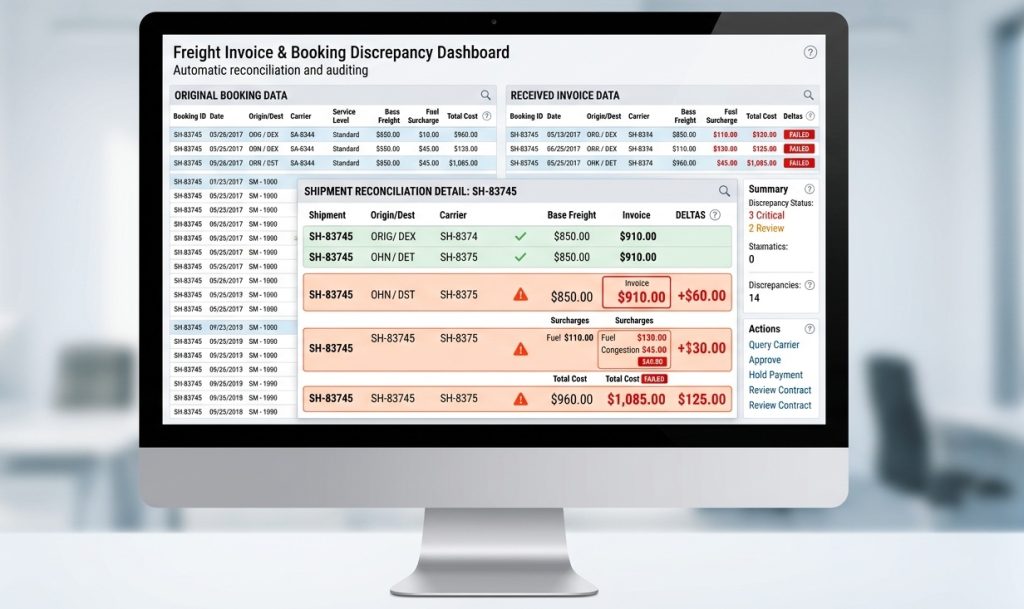
When booking data and invoice data are matched automatically, something happens that manual auditing simply cannot replicate. Every single line is compared against the original booking. Every discrepancy between the expected price and the actual price is flagged. Every surcharge is verified against what was actually ordered.
This doesn’t mean all discrepancies are errors; some are legitimate. A package may have been rerouted, or a weight adjusted at the terminal. But instead of spending time searching for discrepancies, they are served to you directly. You can then spend your time evaluating them instead of trying to find them.
It also changes how you can react. When you can spot trends across months, you can approach the carrier with data in hand. Not “I think prices have gone up,” but “On this service type, the average price has increased by 4.2 percent since March, and here is the documentation.”
The Cost of Not Doing It
The hidden costs of freight auditing have two sides. One is the money overpaid without being noticed. The other is the time spent on manual control that fails to catch what it was supposed to.
For a company with 5–100 employees and a logistics manager who handles many other tasks, the time consumption is often what hurts the most. Invoice audits are either skipped when schedules are full, or performed so quickly that very little is caught. In both cases, the outcome is identical: the company doesn’t actually know what it is paying for.
When Manual Auditing Makes Sense—and When It Doesn’t
Manual control is fine when volume is low. If you have 20 shipments a month, you can easily review them yourself. There is nothing to automate.
However, somewhere between 100 and 300 shipments per month, the dynamic shifts. It becomes impossible to maintain an overview, impossible to catch systemic discrepancies, and impossible to leverage data to negotiate better agreements.
It is not a matter of how skilled the employee is. It is a matter of how many data points a human being can accurately reconcile in a workday. That number is lower than most people think.
FAQ
How much do companies typically overpay without realizing it?
It varies depending on volume, contract structure, and the number of carriers used. However, once booking data and invoice data are systematically reconciled, discrepancies almost always emerge that no one had noticed—often to a surprising extent.
Can’t you just ask the carrier for a breakdown of discrepancies?
Carriers have no interest in doing that work for you. And even if they did, the comparison would need to be made against your booking data, not theirs. The audit must come from your side of the contract.
What does it take to get started with automated reconciliation?
It requires booking data and invoice data to meet in the same system. If you book through a platform that also receives invoice files from carriers, it is essentially a configuration task. If bookings are scattered across multiple channels, the first step is to consolidate them.
Freight auditing is not about catching carriers red-handed. Most errors are unintentional. They happen because freight pricing is complex and data flows through multiple systems before landing on an invoice. But that complexity doesn’t disappear just because you choose to ignore it—it simply becomes an unmapped expense.